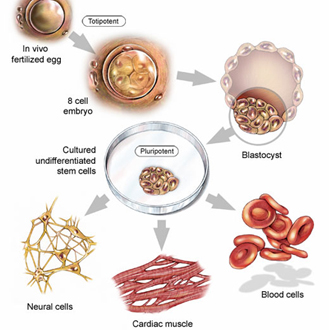
Pluripotent cells (Plures is Latin for many) are those that can differentiate to all cells of the body.
A single cell is formed when a sperm fertilizes an egg. The cell divides into two after a few hours, the two cells divide again and so on. About four days later such division has created, in humans, 60 or so cells. The cells then begin to differentiate forming a hollow sphere called a blastocyst. The blastocyst has an outer layer of cells that will develop to create the placenta. The inner cell mass, consisting of pluripotent cells, will continue to differentiate to form virtually all the body’s tissues.
While the inner cell mass is able to produce many cell types, it is not able to create the cells necessary for fetal development.
Current research is examining the possibility of “stem cell therapies” for diseases, conditions and disabilities such as Parkinson’s and Alzheimer’s diseases, stroke and heart disease. There is considerable work to be done in overcoming the associated technological and ethical challenges.
Stem cells are currently fascinating the world of research. But what are they and why are scientists so interested in them?
What are stem cells?
Stem cells play a central role in the normal growth and development of animals and humans. Normal growth and development, including the maintenance of tissues and organs in the body, require the production of new cells via cell division. However, specialised cells, such as blood and muscle cells, are unable to divide and produce copies of themselves. Instead they are replenished from populations of stem cells, which have the unique ability to divide to produce both copies of themselves and other cell types. Stem cells, therefore, play a crucial role in supporting tissues such as blood, skin, and gut that undergo continuous turnover (cell replacement), and muscle, which can be built up according to the body’s needs and often damaged during physical exertion.
Why are stem cells interesting?
Stem cells have three properties that distinguish them from other types of cells in the body and make them interesting to scientists –
Stem cells are unspecialised
Unlike a red blood cell, which carries oxygen through the blood stream, or a muscle cell that works with other cells to produce movement, a stem cell does not have any specialised physiological properties.
Stem cells are able to divide and produce copies of themselves
Stem cells can divide and produce identical copies of themselves, over and over again. This process is called self-renewal and continues throughout the life of the organism. In contrast, specialised cells such as blood and muscle do not normally replicate themselves, which means that when they are seriously damaged by disease or injury, they cannot replace themselves.
Stem cells have the potential to produce other cell types in the body
In addition to self-renewal, stem cells can also divide and produce cells that have the potential to become other more specialised cell types, such as blood and muscle cells. This process is called differentiation.
Stem cells from different tissues, and from different stages of development, vary in the number and types of cells that they can give rise to. According to the classical view, as an organism develops the potential of a stem cell to produce any cell type in the body is gradually restricted.
(Excerpt from: Institute for Stem Cell Research. National Ovarian Cancer Coalition. 2004)
Images source: www.rso.cornell.edu |