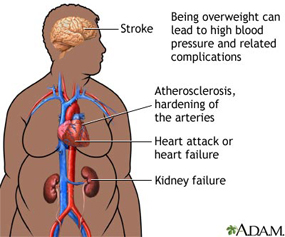
|
A large number of medical conditions have been associated with obesity. Health consequences are categorised as being the result of either increased fat mass (osteoarthritis, obstructive sleep apnea, social stigma) or increased number of fat cells (diabetes, cancer, cardiovascular disease, non-alcoholic fatty liver disease). Mortality is increased in obesity, with a BMI of over 32 being associated with a doubled risk of death. There are alterations in the body's response to insulin (insulin resistance), a proinflammatory state and an increased tendency to thrombosis (prothrombotic state).
Disease associations may be dependent or independent of the distribution of adipose tissue. Central obesity (male-type or waist-predominant obesity, characterised by a high waist-hip ratio), is an important risk factor for the metabolic syndrome, the clustering of a number of diseases and risk factors that heavily predispose for cardiovascular disease. These are diabetes mellitus type 2, high blood pressure, high blood cholesterol, and triglyceride levels (combined hyperlipidemia).
|
Apart from the metabolic syndrome, obesity is also correlated with a variety of other complications. For some of these complaints, it has not been clearly established to what extent they are caused directly by obesity itself, or have some other cause (such as limited exercise) that causes obesity as well.
Image Source: www.nlm.nih.gov
|